


Nature needs YOUR land ethic!
Stay connected through our down-to-earth e-news.


I am probably one of the least “accomplished” of the ALF Fellows. I’m not a likely candidate to be chosen to be profiled in any Alumni newsletters. I always I assumed I would follow the same path that my fellow interns, Josh LaPointe, Steffan Freeman, and Jeffrey Voltz, followed—doing amazing work in the public and private sector, restoring, conserving, and preserving native landscapes. But somewhere amidst it all, life took me in another direction and taught me an unexpected lesson. There are many types of partners in the land ethic. Amongst the general population, many people work in jobs that are primarily chosen based on their circumstances, but that doesn’t mean they can’t have an impact. In order for us to see paradigm shifts, some of us need to not be working to protect, restore, and appreciate the land as our chosen career, but rather making our impact through the way we live - by incorporating those passions into our daily lives simply because it is ethical.
One of my favorite Aldo Leopold quotes is, “There are two things that interest me: the relation of people to each other, and the relation of people to land.” At work I am a program assistant overseeing an academic living-learning community through which sophomore students live in a common dorm, take a course together, and take an excursion together building upon their lessons in the classroom while exploring new cultures. At home, I work on my 1/2 acre plot of land in the village of Hamilton. I get excited, perhaps more than the normal human being, when I find that my native plant seedlings have survived the winter as I survey the land and work to help those plants thrive. And like the Leopolds, who planted pine trees year after year when they didn’t survive, I continue to plant lupine, trying to figure out why they never survive (maybe I need to plant two together?). We focus on introducing plants to the landscape that are native, edible, or were here when we arrived. We do however allow for a bit of nostalgia, adding a few non-invasive species that are a part of our memories, our story.
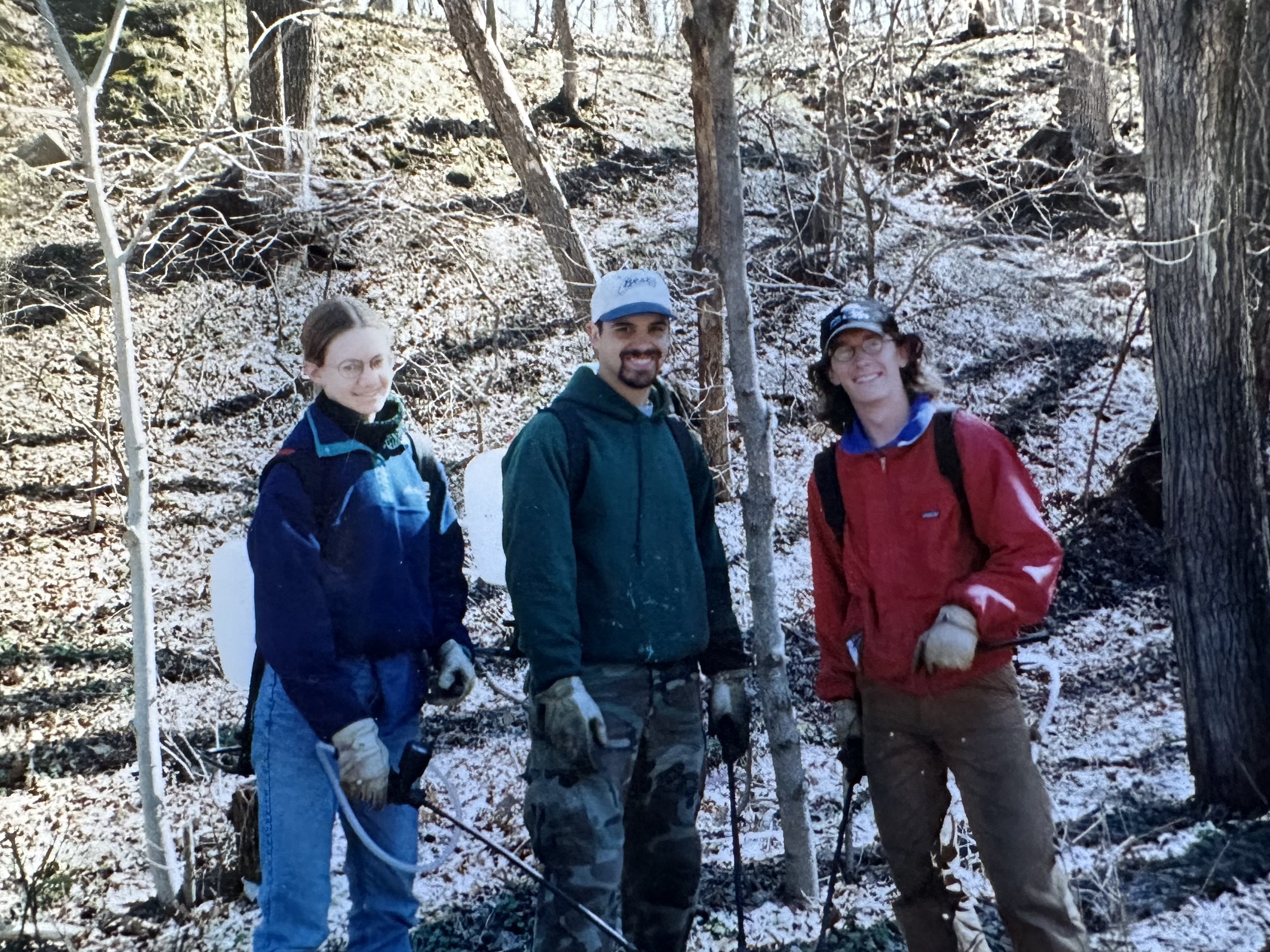
My favorite memories revolve around the sense of community at ALF. I’m glad I began my time at ALF when it was still in its early days - working out of a one room office in downtown Baraboo with staff clustered in a four-sectioned cubicle at the center of the room. As interns we grabbed sandwich fixings out of the refrigerator and every lunch was a sort of a picnic, whether it be sitting on the back of the pick up truck, outside a landowner’s house in a break between prescribed burns or seed collecting adventures, or on the kitchen counter at Nina’s (now Buddy’s) house. On evenings in the summer we gathered at the Shack for potlucks and talks (although sometimes the mosquitoes may have had the larger feast), for volleyball games in downtown Baraboo where we were coached by the fearless Rob Nelson (although I’m not sure we ever lived up to his expectations), or for spending a night at the Shack enveloped in the warmth of the place and the people we were with (while secretly being slightly afraid that somehow we would forget to extinguish the oil lanterns and burn the Shack down, thus never being able to show our face in the Ecology community again). We were awed watching the power of a fire ripping through a prairie as the sun set on the horizon after a long day of work (knowing that there was an overly sufficient back fire to make everything safe of course), or wandering through a savannah feeling like we were walking in the clouds as we collected prairie smoke seed.
Beyond the Leopold family themselves, I also learned lessons from the staff on how to create community—from Buddy giving us the keys to his car on day one when he barely knew us (hire people you trust and then really trust them) to Steve, being conscious that I was the only woman on the crew and thus introducing conversation topics like Ani DiFranco to make sure I felt included (make sure everyone in your team feels seen and appreciated).
I will always think fondly of my time with the Aldo Leopold Foundation. Maybe not the weeks of garlic mustard control…noting as I say that, that I still pull garlic mustard every year from my own property. The Central New Yorkers I have encountered don’t seem to cringe as much at garlic mustard as I do, and they definitely don’t know what to think of me when I look at a meadow and say it looks like it needs a burn.
For now, I work our little plot of land. Any time I hear of someone in search of plants to add to their own landscaping, I always have plants I can split and share. I work to teach my children the power of nature and a respect for the natural world. They are teenagers now, so they might not be as excited as me anymore to catch the first blooms and sights of the season to record in our mini phenology, but together we have picnics atop the Adirondack peaks and relish the various berry seasons.
I wonder what my neighbors think as they walk by my house where the area between the sidewalk and street is filled with prairie plants rather than grass and there are fruit trees and berry bushes in lieu of the usual landscape. So far we’ve had one person turn us into the Village Codes Enforcer (nothing happened, there were no violations), another said we are brave, and most seem to know exactly where we live when we start to describe the wildflowers. For us, it is simply the way to live.
Check out the extraordinary 2001 Leopold Foundation Fellows: Steffan Freeman, Jeffrey Voltz, Josh LaPointe


.svg)

The Aldo Leopold Foundation was founded in 1982 with a mission to foster the Land Ethic® through the legacy of Aldo Leopold, awakening an ecological conscience in people throughout the world.
"Land Ethic®" is a registered service mark of the Aldo Leopold Foundation, to protect against egregious and/or profane use.


Stay connected through our down-to-earth e-news.